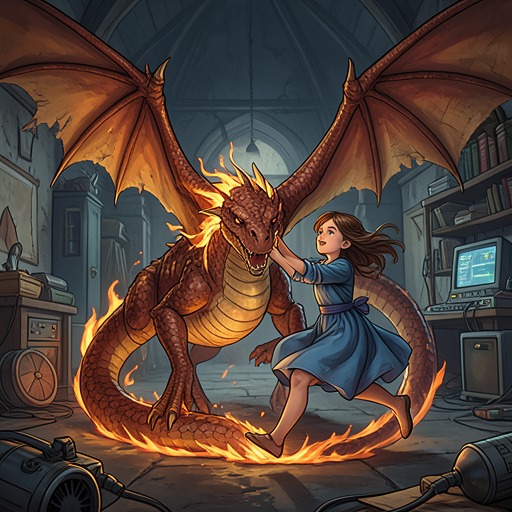
Balerion Takes Aerea to Valyria
Fire & BloodBalerion Takes Aerea to Valyria is Septon Barth’s explanation for the disappearance and fatal return of Princess Aerea Targaryen, who fled Dragonstone on the Black Dread. The journey is never witnessed or described directly: Barth reconstructs it from Aerea’s condition, Balerion’s injuries, and the princess’s unexplained absence. His account turns a missing child and a returned dragon into evidence of a destination that the court could neither confirm nor safely discuss.
Flight and the Unmastered Dragon
Aerea fled Dragonstone at dawn, entering the yards and claiming a dragon for herself. She chose Balerion, the oldest and largest of the living dragons, rather than one of the younger, more tractable mounts. She was not yet thirteen and had never ridden a dragon before. Her mother, Rhaena Targaryen, was furious and feared that the choice was intended to wound her: Balerion had been the dragon of Maegor the Cruel, the man who had killed Aerea’s father. Alysanne Targaryen tried to calm Rhaena by reminding her that Aerea was an angry child, but Rhaena’s immediate concern was finding her daughter.
The court first looked for Aerea in places she might plausibly have chosen. Rhaena suspected King’s Landing, where Aerea had wanted to return; Fair Isle and Oldtown were also considered. Others thought she might have gone east, perhaps seeking the Free Cities and escape from her mother’s reach. Yet Rego Draz’s agents found no trace of either princess or dragon across the Narrow Sea. These failed searches would later help Barth argue that the question had been framed incorrectly: rather than ask where Aerea had taken Balerion, he proposed asking where Balerion had taken Aerea.
Barth could not establish what Aerea had intended. She might have meant to fly to King’s Landing, seek her twin sister in Oldtown, or find Elissa Farman, who had once promised to take her adventuring. These remain possibilities, not confirmed plans. In Barth’s account, whatever destination Aerea chose mattered less than the imbalance between an inexperienced rider and a dragon as old and willful as Balerion. He reasoned that she lacked the knowledge and strength of will to direct him once she had mounted.
Balerion’s Return
On the thirteenth day of the fourth moon of 56 AC, a guard in a watchtower above Blackwater Bay spotted dark wings and sounded the alarm. He blew again as they grew nearer and a third time when the dragon became clear against the clouds. Balerion had returned to King’s Landing after years away from its skies. His appearance frightened people who wondered whether Maegor had somehow returned to ride him; instead, a dying child clung to his neck.
Balerion landed in the inner ward by Maegor’s Holdfast. Aerea slipped from his back and collapsed after asking for help. She was scarcely recognizable to people who had known her at court: her clothing was in tatters, her hair was matted, and she appeared severely weakened. Ser Lucamore Strong carried her from the ward to Grand Maester Benifer. He later described her fever and distress, but Jaehaerys Targaryen ordered him not to speak further about the princess.
Jaehaerys and Alysanne were called to Benifer’s chambers, but the Grand Maester refused them entry, judging that they should not see Aerea in her condition. Guards kept servants away; only Barth entered, to perform the rites for the dying. Benifer tried to treat the fever, while crowds gathered in the Red Keep’s sept to pray and the king and queen kept vigil outside the chamber. Aerea died that evening. Balerion’s return had brought the missing princess home, but it did not restore her to her family.
Death and Concealment
The next morning, Aerea’s body was wrapped in white linen and committed to the flames. Jaehaerys announced that his niece had died of a fever and asked the realm to pray for her. King’s Landing mourned briefly, then resumed its ordinary life. The public explanation was not wholly false, Barth later acknowledged, but it concealed the nature of the illness and what Benifer and Barth had witnessed while Aerea was dying.
Barth wrote privately that he and Benifer had agreed not to tell anyone the whole of what they had seen—not the king, the queen, Aerea’s mother, or even the archmaesters. His account describes an extreme fever and signs of living things moving beneath Aerea’s skin, which neither the ordinary description of a fever nor the court’s public explanation could account for. The testimony does not establish what those things were or how they entered her; it records the limits of the witnesses’ understanding as much as it records their fear. Benifer’s own journals and letters, usually a detailed record of what he observed in royal service, contained no account of Aerea’s return or death.
Barth’s Reconstruction and the Unanswered Mystery
Barth’s proposed destination was Valyria. He reasoned that Balerion alone among the dragons of Aegon’s conquest had come to Dragonstone with Aenar the Exile and Daenys the Dreamer, and that he might therefore have known Valyria before the Doom. Barth concluded that the dragon had carried Aerea there, probably without her willing control. This was an inference rather than a witnessed fact: Barth admitted that he could not say what happened during the journey or what befell the princess in Valyria.
He connected that theory to the condition in which Aerea returned and to Valyria’s reputation for blood magic and other dark arts. In his account, the land was not necessarily empty: the living things he believed had been found inside Aerea might still dwell there, alongside horrors beyond the witnesses’ knowledge. His words leave the precise cause of her suffering unexplained, while making the journey’s possible destination more disturbing than any of the places the court had searched.
Balerion also returned with injuries no one at court remembered seeing before, including a long wound along his side. Barth treated this as further evidence that the dragon had encountered something dangerous, but it does not independently prove that he had gone to Valyria. He never returned to Aerea’s fate in his writings, and his account remained among his private papers for almost a century. The experience nevertheless sharpened the curiosity he called his abiding sin and preceded his investigations into dragons and other unnatural creatures. Thus the event ends not with a confirmed explanation but with a hidden testimony: a child dies, the greatest dragon returns marked, and the scholar who records the mystery insists that some doors are better left unopened.